

From neurons to animal collectives
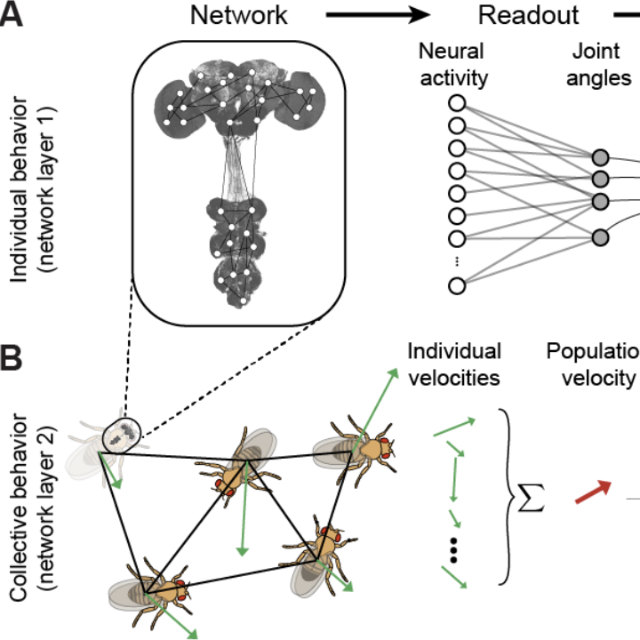
Neuroscience and the study of collective behaviour share a major goal: understanding how dynamic interactions between individual elements give rise to the behaviour of a population, whether of neurons or of animals. This goal has recently come within reach, thanks to techniques that give access to the connectivity and activity of neuronal ensembles, as well as to behaviour in animal collectives. The next challenge is to use these datasets to unravel the network mechanisms that generate population behaviours.
A network-theory view of behaviour
Network theory, the study of structure-function relationships in interconnected systems, is well placed to help. In this review, written with Pavan Ramdya, we survey studies that have taken a network view of modern datasets to gain insight into individual and collective animal behaviour. We focus on how analysing signal propagation, controllability, symmetry and geometry of networks can tame the complexity of collective system dynamics, and how these approaches can accelerate our understanding of behaviour across ethological scales.