

Nitrogen assimilation in E. coli
In Escherichia coli, ammonium assimilation is regulated by two paralogous proteins, GlnB and GlnK. Together they orchestrate interactions with regulators of gene expression, transport proteins and metabolic pathways. Yet how they jointly modulate the activity of glutamine synthetase, the key enzyme for nitrogen assimilation, was poorly understood.
Combining experiments and a biochemical model
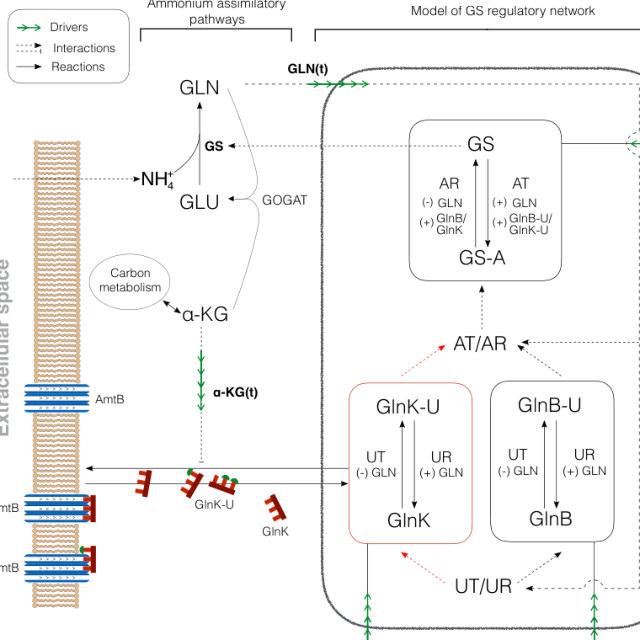
We combined experiments and theory to study the dynamic roles of GlnB and GlnK during nitrogen starvation and upshift. We measured time-resolved in vivo concentrations of metabolites, and of total and post-translationally modified proteins. We then developed a concise biochemical model of GlnB and GlnK that incorporates competition for active and allosteric sites, as well as the functional sequestration of GlnK. The model predicts how glutamine synthetase, GlnB and GlnK respond to time-varying external ammonium levels, both in the wild type and in two genetic knock-outs.
What we found
GlnK is tightly regulated under nitrogen-rich conditions, yet it is expressed when ammonium runs out and during starvation. This suggests that GlnK acts as a buffer against nitrogen shock after starvation, and it provides a further functional link between nitrogen and carbon metabolism.
The proteomic and metabolic data and the mathematical model are available on figshare.