

How is activity routed across the brain?
Behaviour requires distributed neural processing to be flexibly integrated and segregated, which in turn demands that information is dynamically routed across the brain. Whether a unifying principle governs the routing of neural activity has been unknown.
Canonical routing modes
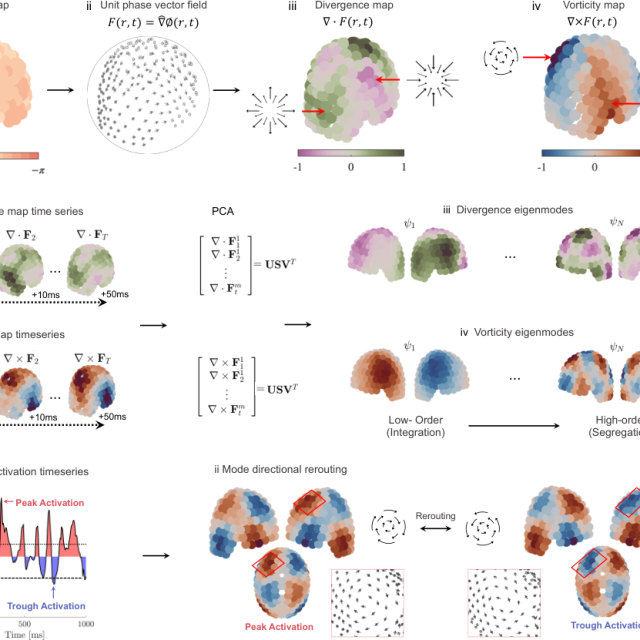
In this collaborative study, we derived the time-varying unit-phase vector field of cortical activity from electroencephalogram (EEG) recordings, and constructed routing modes from its divergence and vorticity. We found that the flow of cortical activity is directed through canonical routing modes that are conserved across individuals, and robust to variations in age, frequency band, brain state and even the presence of neurodegeneration. These modes are flexibly combined to generate distinct, state- and function-dependent flow architectures that remain consistent across individuals.
Links to Alzheimer’s disease
Disrupted routing-mode dynamics mechanistically link structural abnormalities and cognitive impairment in Alzheimer’s disease. Together, the canonical routing modes provide a unified framework for describing, modelling and predicting the dynamic integration and segregation of the macroscopic brain activity that underpins behaviour.
See also RVGP, our method for reconstructing high-density brain dynamics from low-density EEG.